

A coffee bag may look good in photos but fail after delivery. I have seen flat bags turn wrinkled, printed bags smell bad, and weak seals ruin whole orders.
I check coffee bag quality1 before a bulk order2 by looking at bag flatness3, smelling for solvent odor4, reviewing printing quality5, and testing airtightness. These four checks help me avoid poor materials, weak process control, and costly packaging mistakes.
I learned this lesson through real export work. A low price can look attractive at first. But a bad coffee bag can damage the coffee, the brand image, and the customer’s trust very fast.
How Do I Check Coffee Quality?
Good coffee packaging starts with a simple question: what exactly am I checking? I am not only checking the coffee itself. I am also checking whether the bag protects coffee quality well.
I check coffee bag quality1 by focusing on four practical points: flatness, odor, print quality, and seal performance6. These signs tell me whether the supplier controls lamination, curing, printing, and bag making well enough for a bulk order2.
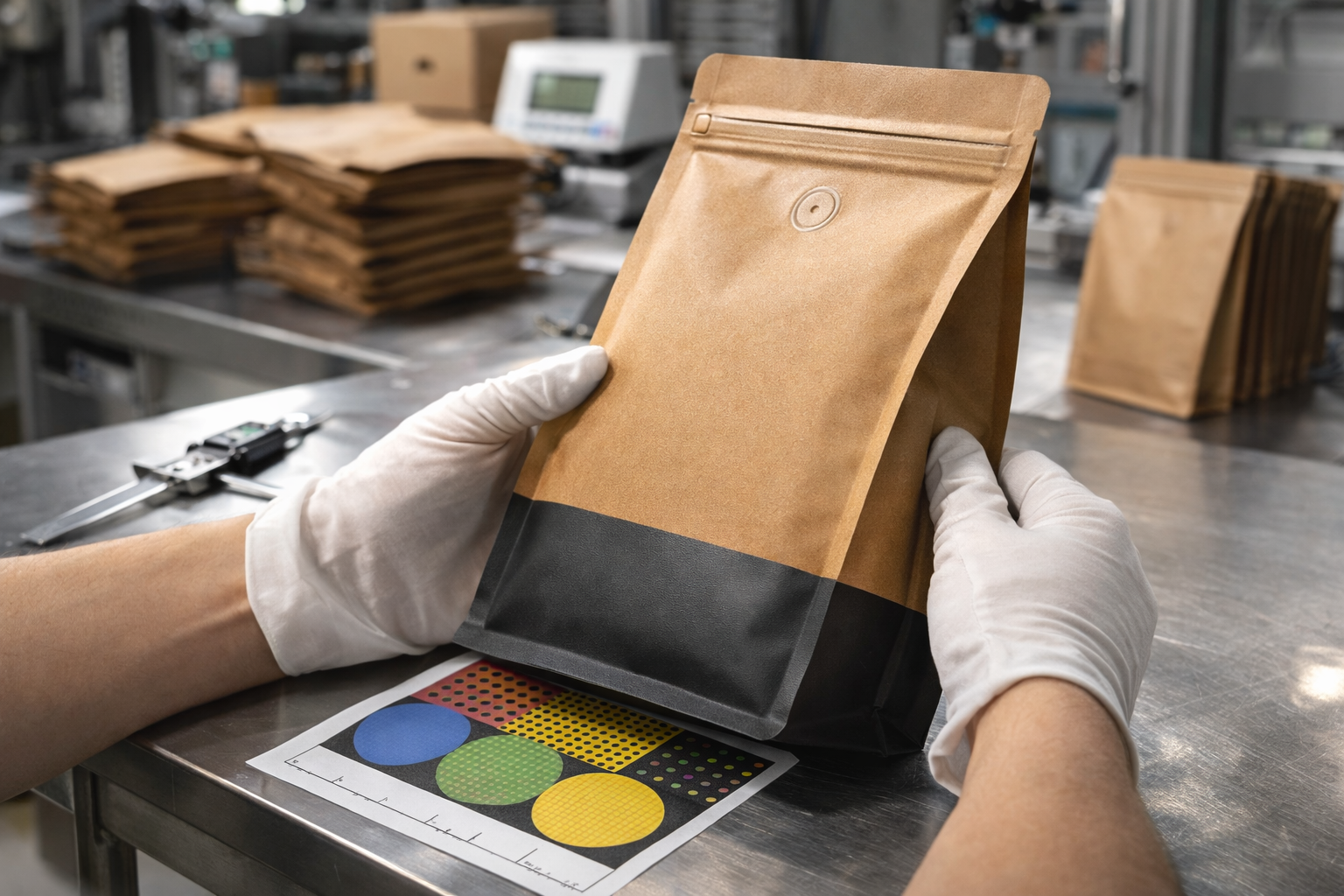
When I review a coffee bag sample, I do not start with design. I start with the physical result. A coffee bag is a technical product first. The artwork matters, but performance matters more.
Why I start with bag flatness3
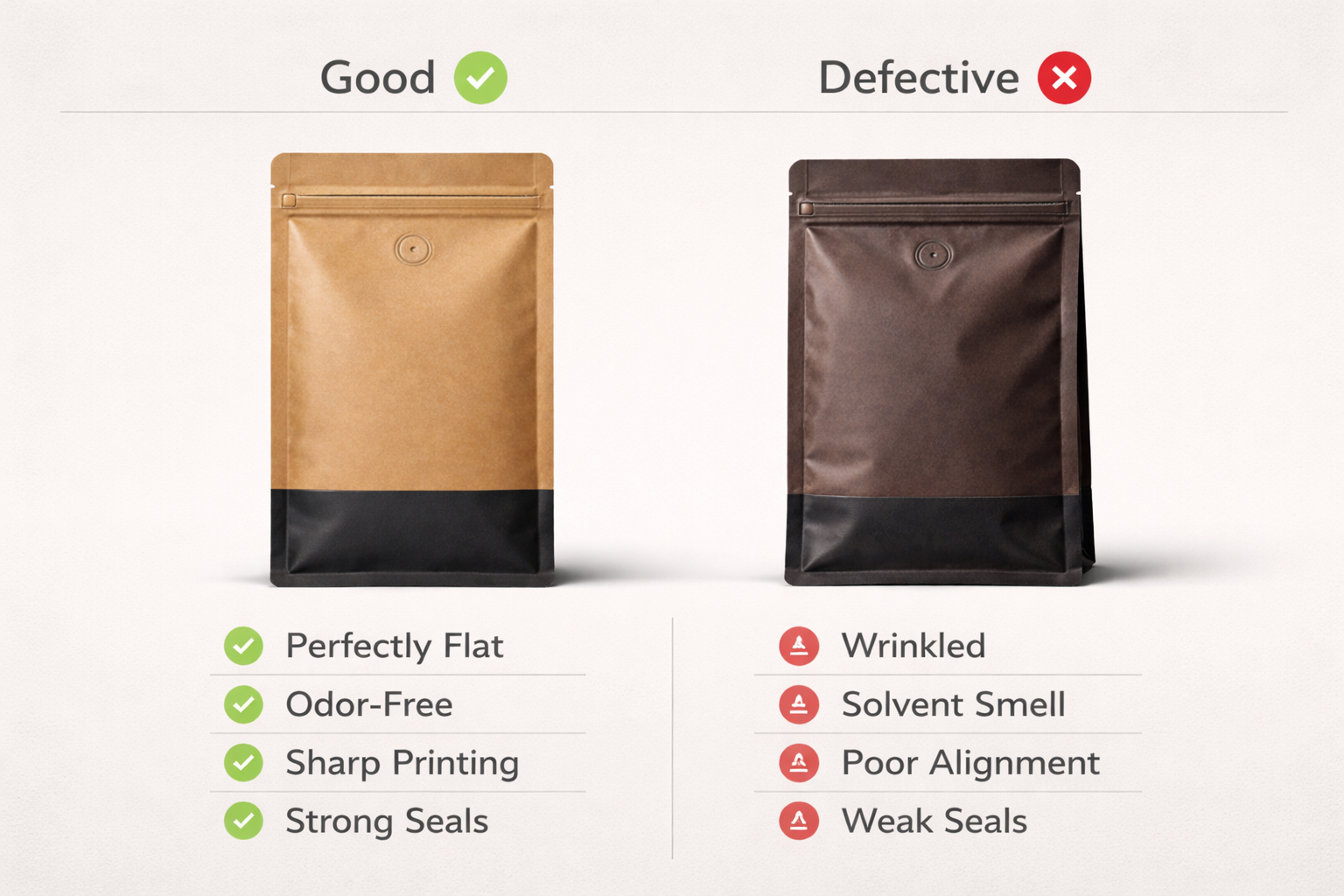
The first thing I look at is flatness. If the bag body looks smooth and neat, that usually tells me the factory handled temperature and machine speed well during production.
A bag that curls, wrinkles badly, or shows uneven tension often points to poor process control. That may not always cause failure right away, but it is often a warning sign.
What good flatness tells me
| Check point | What I look for | What it may mean |
|---|---|---|
| Front surface | Smooth and even | Good lamination and tension control |
| Side edges | Straight and clean | Stable bag making process |
| Bottom area | Balanced and firm | Better structure and shelf standing |
| Zipper area | No wave or distortion | Better heat sealing control |
If the bag lies flat and looks balanced, I usually feel more confident about the supplier’s production skill.

Why I always smell the bag
This is one of the most ignored checks, but I think it is one of the most important. I open the bag and smell it carefully. If I notice a sharp or irritating odor, I treat it as a serious problem.
In many cases, that smell means the curing time was not enough after lamination. This can leave solvent residue inside the packaging material.
What I do when I smell a strong odor
I do not accept excuses like “it is normal” or “the smell will go away later.” I ask the supplier to redo it or explain the curing process clearly. Coffee is very sensitive to odor. If the bag smells bad, the product inside can absorb that smell.
For coffee packaging, this is a real risk. It can hurt flavor, customer experience, and repeat orders.
Why printing quality5 matters more in bulk order2s
I also check whether the printing is sharp, even, and rich in color. At IMIPAK, for bulk order2s, we usually suggest gravure printing7. In my experience, it gives the clearest image, the best color consistency, and the most stable result for large production.
For small orders, digital printing8 is also possible. It is flexible and fast, but the unit cost is usually higher.
What I check in printing
| Printing item | Good result | Warning sign |
|---|---|---|
| Text clarity | Sharp and readable | Fuzzy letters |
| Color blocks | Even and strong | Patchy or dull color |
| Registration | Layers aligned well | Misaligned images |
| Surface finish | Clean and consistent | Scratches or dirty marks |
A coffee bag is often the first thing the buyer sees. If the printing looks weak, the brand looks weak too.
Why airtightness is not optional
Last, I check seal integrity and airtightness. Coffee bags need good barrier and good sealing. If the seal fails, the coffee loses freshness faster.
I often suggest a simple water-fill test for empty bags. I also ask the supplier to provide airtightness test videos before shipment. A real test tells me much more than a verbal promise.
What Are the 4 Enemies of Coffee?
Coffee is delicate, so the packaging has to fight against several common threats. When I choose a coffee bag, I always think about what the bag must protect against.
The four main enemies of coffee are oxygen, moisture, light, and heat. A good coffee bag reduces exposure to all four by using proper barrier materials, strong sealing, and the right pouch structure.
This is why I never judge a coffee bag only by appearance. A nice-looking bag is not enough if it cannot protect the beans.
How each enemy affects coffee
| Enemy | What it does to coffee | What I expect from the bag |
|---|---|---|
| Oxygen | Speeds up staling | Strong barrier and good seals |
| Moisture | Damages texture and flavor | Moisture resistance |
| Light | Hurts aroma and oils | Opaque materials |
| Heat | Speeds up quality loss | Stable laminated structure |
Why this matters during supplier selection9
If a supplier cannot explain how the material protects coffee from these four enemies, I get cautious. A real packaging supplier should understand coffee product needs, not just bag dimensions.
This is one reason I believe coffee packaging should not be treated like a generic bag project. It needs product knowledge and production experience together.
How Do I Choose the Best Coffee Packaging?
Many buyers ask this question too early. They start with style, color, or finish. I start with function.
I choose the best coffee packaging by matching barrier performance, bag style, print method, order size, and brand position. The best packaging is not the most expensive one. It is the one that protects coffee well and fits the selling plan.
For example, the most regular bag type in the market is still the middle seal bag10. It is practical and cost-friendly. A newer and more premium choice is the flat bottom bag11, also called the eight-side seal style by many buyers. This style supports hot stamping and UV finishing very well, so it helps the brand stand out on the shelf.
My way to choose the right coffee packaging
Step 1: Check product needs
I ask whether the coffee is whole bean or ground coffee. I ask about valve needs, zipper needs, and target shelf life.
Step 2: Match the bag style
I choose a style based on budget and shelf effect.
| Bag style | Best for | My view |
|---|---|---|
| Middle seal bag | Standard bulk use | Practical and proven |
| Stand-up pouch | Simple retail display | Easy and flexible |
| Flat bottom bag | Premium shelf display | Strong branding effect |
| Side gusset bag | Traditional coffee format | Good volume use |
Step 3: Match printing to order size
For large volume orders, I prefer gravure printing7. The result is clear, even, and stable. For smaller orders, digital printing8 is useful, but the price is higher.
Step 4: Confirm quality checks before shipment
Even a good structure can fail if production control is poor. So I still check flatness, odor, print quality, and airtightness before final approval.
What Is the 80 20 Rule for Coffee?
This idea is useful in packaging too. I do not apply it as a strict formula, but I do use its logic.
The 80 20 rule12 for coffee means a small number of choices often drive most of the results. In packaging, a few key factors like material barrier, sealing quality, and print control often decide most of the final product performance.
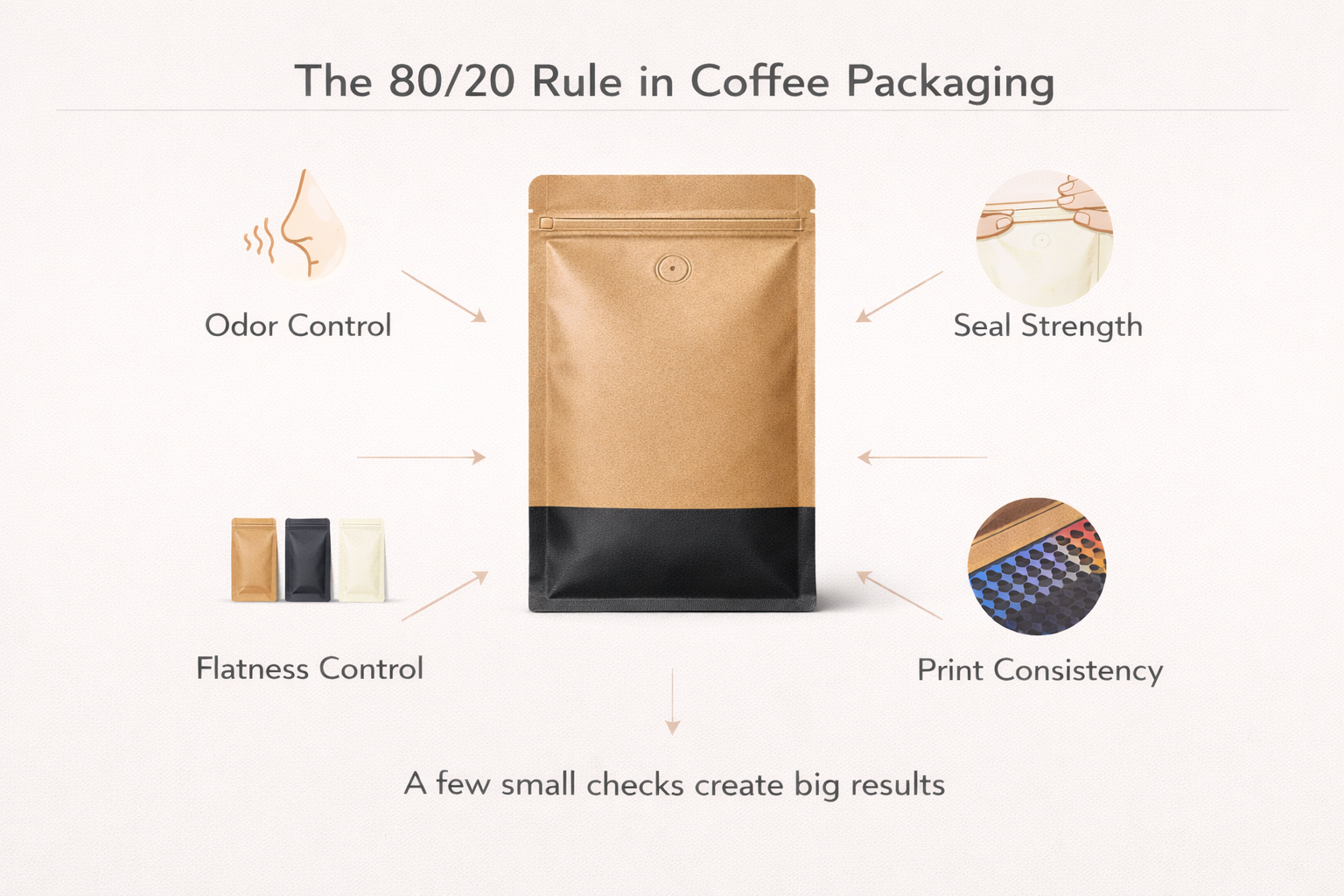
In my work, I see that buyers can spend too much time on minor design details while missing major technical risks.
The small checks that create big results
| Small area | Big result |
|---|---|
| Odor control | Better product safety and user experience |
| Seal strength | Better shelf life |
| Flatness control | Better visual quality and machine runnability |
| Print consistency | Better brand image |
This is how I use the 80 20 idea: I focus first on the few quality points that prevent the biggest losses.
How Can I Tell If Coffee Packaging Is High-Quality?
A high-quality coffee bag should feel right, look right, and perform right. I need all three.
I can tell coffee packaging is high-quality when it is flat, clean, odor-free, well printed, and tightly sealed. High-quality bags also use suitable materials, stable lamination, and reliable production control across the full order.
My quick quality checklist
Appearance check
The pouch should be neat, balanced, and free from visible defects.
Smell check
The inside should not have a strong chemical smell.
Printing check
The design should be clear, rich, and consistent.
Sealing check
The seals should look firm, even, and leak-resistant.
Why samples are not enough by themselves
A good sample is helpful, but it does not guarantee a good bulk order2. I always want consistency. A supplier may make one good sample and still fail in mass production.
That is why I ask about inspection steps before shipment. At IMIPAK, we do strict quality inspection13 before delivery. I believe that matters just as much as the sample itself.
Who Makes the Best Coffee Bags?
There is no single answer for every buyer. The best supplier depends on quality control, communication, flexibility, and real coffee packaging experience14.
The best coffee bag supplier is the one that delivers stable quality, clean printing, no bad odor, reliable sealing, and honest communication. For me, experience in coffee packaging matters more than a low quote alone.

I say this very directly: the best coffee bag maker is not always the biggest one. It is the one that helps the buyer avoid problems.
At IMIPAK, our high repeat-order coffee bag sizes are 250g, 500g, and 1kg. We can also accept low MOQ customization, and we can ship fast in as little as 2 to 5 days for some projects. I believe this matters because many buyers want to test a market first, not lock into a huge risk.
What I expect from a good supplier
| Supplier ability | Why I care |
|---|---|
| Strict inspection before shipment | Reduces hidden defects |
| Honest feedback on material and printing | Builds trust |
| Strong gravure printing7 for bulk order2s | Improves brand image |
| Support for small custom orders | Helps market testing |
| Fast response and fast shipping | Saves time |
What Are the 7 Types of Packaging?
When buyers ask this, I usually narrow the answer to practical packaging forms used around products in general and pouches in particular.
Seven common packaging types15 include bags, pouches, boxes, bottles, cans, sachets, and wraps. In coffee, the most useful flexible packaging types15 are stand-up pouches, flat bottom bag11s, side gusset bag16s, and middle seal bag10s.

This question matters because not every packaging type fits coffee. Coffee needs barrier, sealing, and often a valve. So I stay focused on structures that really work for beans and ground coffee.
The packaging types15 I see most in coffee work
| Type | Used for coffee? | My view |
|---|---|---|
| Stand-up pouch | Yes | Flexible retail choice |
| Flat bottom bag | Yes | Premium display |
| Side gusset bag | Yes | Traditional and efficient |
| Middle seal bag | Yes | Standard and practical |
| Box | Sometimes | Outer pack only |
| Can | Sometimes | Special format |
| Sachet | Yes, for instant coffee | Different use case |
What About Top Coffee Brands, Bag Brands, and Luxury Bags?
Some buyers search these terms when they compare “bag quality,” but these topics can easily get mixed together. Coffee packaging bags are not the same as fashion handbags.
Top coffee brands or luxury bag brands may be interesting for market research, but they do not tell me whether a packaging supplier can make a safe, odor-free, airtight coffee bag. For bulk coffee packaging, factory process control matters far more.

I understand why these search terms appear. People often want to know who is “number one.” But in B2B coffee packaging, I think that is the wrong question.
The better questions I ask instead
Which company makes the best bags?
I ask: which supplier gives stable quality and honest service?
What are the top 5 bag brands?
I ask: which factories have repeat orders and proven coffee pouch experience?
How do I choose a good quality bag?
I ask: is the bag flat, odor-free, well printed, and airtight?
Which is the cheapest luxury bag?
I ask: does a low price create a higher risk later?
That shift in thinking helps me make better sourcing decisions.
Conclusion
I do not judge a coffee bag by price alone. I check flatness, odor, printing, and airtightness first. That is how I reduce risk and choose a supplier with confidence.
-
Understanding coffee bag quality is crucial for maintaining product integrity and brand image. ↩ ↩
-
Checking key factors before a bulk order minimizes risks and ensures quality. ↩ ↩ ↩ ↩ ↩ ↩
-
Bag flatness indicates production quality and can prevent future packaging issues. ↩ ↩
-
Identifying solvent odor can prevent flavor contamination and ensure product safety. ↩
-
High printing quality enhances brand perception and attracts customers. ↩ ↩
-
Good seal performance ensures freshness and extends shelf life of coffee. ↩
-
Gravure printing offers superior quality and consistency for bulk orders. ↩ ↩ ↩
-
Digital printing is flexible and fast, ideal for smaller orders. ↩ ↩
-
Choosing the right supplier is crucial for consistent quality and service. ↩
-
Middle seal bags are practical and cost-effective for standard bulk use. ↩ ↩
-
Flat bottom bags provide a premium display and strong branding opportunities. ↩ ↩
-
Applying the 80 20 rule helps focus on critical factors that impact quality. ↩
-
Quality inspection reduces hidden defects and ensures product reliability. ↩
-
Experience in coffee packaging leads to better understanding of product needs. ↩
-
Understanding packaging types helps in selecting the right option for coffee. ↩ ↩ ↩
-
Side gusset bags are traditional and efficient for coffee packaging. ↩
